
Advancements in maize cultivation : synergistic effects of dry atmospheric plasma combined with plasma-activated water
– Authors : J.-P. Kamseu-Mogo, M. Soulier, G. Kamgang-Youbi, H. N. Apala Mafouasson, T. Dufour
– References : J. Phys. D : Appl. Phys. 58, 055201, 17 pp (2025)
– Links : DOI, Free download
Abstract
In this study, we investigate the effects of pre-germinative and post-germinative plasma treatments, applied separately or in combination, to improve maize germination and early seedling development. Pre-germinative treatment consists of priming the seeds with a dry atmospheric plasma (DAP) generated by a dielectric barrier device (DBD), characterized by minimal radiative emission, low electrical power (4 W) and high emissions of O, OH and NO radicals. Post-germinative treatment, known as plasma-activated water (PAW), uses a single-pin electrode device (SPED) to generate a DC discharge that features a power of 126 W and produces large amounts of OH radicals. The resulting PAW, after 5 minutes of SPED treatment, induces a slight acidification and increased concentrations of nitrate ions (from 24 to 250 mg/L), nitrite ions (from less than 0.1 to 56.1 mg/L) and hydrogen peroxide (from 0.3 to 18.5 mg/L). Results indicate that DAP applied on maize seeds for 20 min boosts their germination rate up to 90% (versus only 65% for untreated seeds) while reducing the median germination time by 37.5%. Then, seedling growth monitoring is achieved on control, DAP, PAW and DAP+PAW groups to assess stem length, hypocotyl length, leaf count, collar diameter and fresh/dry mass. The DAP+PAW group shows the most robust growth, demonstrating a synergistic effect of the combined treatments, particularly with significantly longer stem lengths. Additionally, physiological analyses of seedling leaves indicate a decrease in chlorophyll content despite enhanced growth, while fluorescence microscopy reveals a reduction in stomatal density in leaves treated with DAP and PAW, especially in the combined treatment group, potentially impacting photosynthetic efficiency and water regulation.
Treatment of seeds by cold ambient air plasma : Combining impedance measurements with water sorption modeling to understand the impact of seed hydration
– Authors : J. August, C. Bailly, T. Dufour
– References : Journal of Physics D : Applied Physics. Vol. 57, No 26 (2024)
– Links : DOI, Free download
Abstract
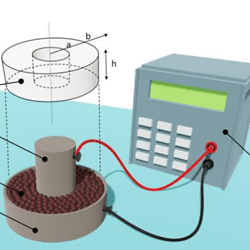
In this article, we focus on the plasma seed interaction and more specifically-on the feedback exerted by the seeds on the plasma properties. Dormant Arabidopsis seeds with different water contents (WC), namely 3 %DW, 10 %DW and 30%DW were exposed to cold ambient air plasma (C2AP) generated in a dielectric barrier device (DBD). It is found that increasing WC enhances the capacitive current of the DBD, generates a greater number of low energy streamers (characterized by current peaks lower than 10 mA) that preferentially interplay with the seeds. Since the resistive and capacitive components of the seeds modify the C2AP electrical properties, impedance measurements (also called LCRmetry) have been carried out to measure their main dielectric parameters before/after plasma exposure (seeds resistance, capacitance, complex relative permittivity, tangent loss and conductivity). It appears that WC significantly changes dielectric losses at low frequencies (< 1 kHz) due to polarization relaxation of the polar molecules (i.e. water). LCRmetry further reveals that C2AP does not substantially alter seeds dielectric parameters, i.e. it neither adds or removes significant amounts of new materials, meaning that the relative starch, protein and lipid contents remain essentially unaffected. However, it cannot be discounted that some bulk properties of the Arabidopsis seeds may be modified, especially regarding their porosity. This characteristic could facilitate penetration of plasma-generated reactive oxygen species into the internal seed tissues, leading to the grafting of oxygenated groups. To corroborate this theory, water sorption isotherms have been achieved on Arabidopsis seeds and fitted with four thermodynamic models, including the Brunauer-Emmett-Teller model and the Generalized D’Arcy and Watt model. It is demonstrated that C2AP primarily strengthens water-seed affinity by modifying molecular interactions rather than changing the seed’s moisture layer. This occurs despite a potential decrease in the number of adsorption sites, indicating a significant increase in overall seed hydrophilicity after plasma treatment.
Cold plasma treatment boosts barley germination and seedling vigor : Insights into soluble sugar, starch, and protein modifications
– Authors : M. A. Benabderrahim, I. Bettaieb, H. Hannachi, M. Rejili, T. Dufour
– References : Journal of Cereal Science, Vol. 116, 103852 (2024)
– Links : DOI, Free download
Abstract
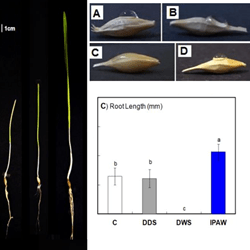
This study investigates the impact of three cold plasma treatments on barley seed germination: direct treatment of dry seeds (DDS), direct treatment of water-soaked seeds (DWS), and indirect treatment of seeds using plasma-activated water (IPAW). Our findings reveal that while DDS maintained the seed’s imbibition structures, DWS significantly reduced water uptake. Notably, DWS-treated seeds exhibited a substantial increase in moisture content, potentially leading to an oxygen-deficient environment within the seed. This condition appeared to hinder germination, contrasting with the beneficial effects observed in DDS-treated seeds. Analyses of surface hydrophilicity, phenolic compounds, carbohydrate composition, protein storage and seedling growth were conducted. Interestingly, cold plasma treatment enhanced seed surface hydrophilicity, as evidenced by a decrease in water contact angles, particularly for DWS. We observed specific reductions in flavonoids and total phenolics, alongside shifts in carbohydrate composition, including increased sugar content up to 15.1% (DDS) and 13.5% (DWS), accompanied by a decrease in starch content to 189.00 ± 7.86 mg/g FM for DWS. Protein storage assessments revealed declines in albumin, globulin and prolamin fractions post-CP exposure. Finally, DDS and IPAW treatments markedly improved seedling shoot growth (from two to three-fold), underscoring the potential of these treatments in enhancing barley germination.
Release of Arabidopsis seed dormancy by cold atmospheric plasma relies on cytoplasmic glass transition
– Authors : J. August, T. Dufour, C. Bailly
– References : J. Phys. D : Appl. Phys., Vol. 56, No. 41,415202 (2023)
– Links : DOI, Free download
Abstract
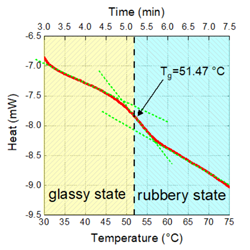
When mature Arabidopsis thaliana seeds are dormant, their germination is prevented in apparently favourable conditions. This primary dormancy can be released during seed dry storage through a process called after-ripening whose duration can last several months. To reduce this delay, cold atmospheric plasmas (CAP) can be used as sources of reactive oxygen species capable of inducing heterogeneous chemical reactions. While CAP are known to stimulate the germination of various seed species, the relationship between CAP treatments and the amorphous solid state of dry seeds remains unexplored. Here, we demonstrate that seed dormancy can be alleviated using a cold plasma of ambient air and that this alleviation can be amplified for seeds with high water-content (typically 30 %DW) or seeds heated at 60 °C during plasma treatment. Differential scanning micro-calorimetry shows that these characteristics control the glassy/rubbery state of the seed cytoplasm. This technique indicates also that a glass transition to the rubbery state strengthens the CAP effects to alleviate seed dormancy. We propose that lower cytoplasmic viscosity can promote the oxidative signaling induced by CAP which, in turn, improves the germination process

Les plasmas froids et le Vivant, de nouvelles avancées
– Authors : C. Douat, J. Santos Sousa, T. Dufour
– References : Reflets de la Physique, Vol. 75, pp. 24-30 (2023)
– Links : DOI, Free download
Abstract
Depuis le début des années 2000, des avancées technologiques majeures ont permis l’émergence de plasmas froids à pression atmosphérique ayant de faibles valeurs de courant et des températures proches de la température ambiante. Dans cet article, nous exposons dans un premier temps les principales sources de plasma froid utilisées avec succès dans les applications biomédicales, en insistant notamment sur les propriétés physico-chimiques recherchées. Dans un second temps, nous proposons un état de l’art des dernières avancées médicales (en particulier en cancérologie et en dermatologie), ainsi qu’en agriculture.
Cold plasma treatment of seeds : deciphering the role of contact surfaces through multiple exposures, randomizing and stirring
– Authors : T. Dufour, Q. Gutierrez
– References : J. Phys. D : Appl. Phys., Vol. 54, N° 50, 505202, 16pp (2021)
– Links : DOI, HAL (free download)
Abstract
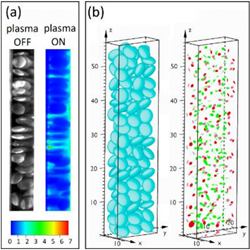
Cold plasma technologies are an efficient approach to improve the germination properties of seeds, especially in a stacking configuration within a dielectric barrier device. In such dry atmospheric plasma priming process, we show that a helium-nitrogen plasma treatment of 20 min can reduce the median germination time of lentil seeds from 1420 min to 1145 minutes, i.e. a gain in vigor of 275 min (or +19.4 %). Considering that this result depends on the plasma-seed interaction and therefore on the contact surfaces between the seeds and the plasma, a topographic modeling of a 100 seeds-stack is performed in the dielectric barrier device. This model drives to the distinction between the seed-seed contact surfaces (276 contacts standing for a total area of 230.6 mm2) and the seed-wall contact surfaces (134 contacts standing for a total area of 105.9 mm2). It turns out that after a single plasma treatment, the outer envelope of each seed is 92% exposed to plasma: a value high enough to support the relevance of the plasma process but which also opens the way to process optimizations. In this outlook, we propose to replace the single 20-minute plasma treatment by a “plasma sequence”, i.e. a succession of shorter plasma treatments whose total duration remains 20 minutes. Between two successive plasma treatments, the seeds can follow either a trapping procedure (seeds in same positions and orientations) or a randomizing procedure (seeds in same positions but reoriented) or a stirring procedure (seeds vigorously shaken). As an example, a sequence of 10 plasma treatments (upon 2 minutes) separated by short stirring procedures leads to a gain in vigor as high as 405 min (+28.5 %) vs 275 min (+19.4 %) for a single plasma treatment of 20 min. We propose to understand these results by correlating the gain in vigor with the water uptake of the seeds (increase from 29% to 55%) and the wettability state of their coating (decrease of contact angle from 113.5° to about 38°).

Sustainable improvement of seeds vigor using dry atmospheric plasma priming : Evidence through coating wettability, water uptake, and plasma reactive chemistry
– Authors : T. Dufour, Q. Gutierrez, C. Bailly
– References : Journal of Applied Physics, Vol. 129, 084902 (2021)
– Links : DOI, HAL (free download)
Abstract
Lentil seeds have been packed in a dielectric barrier device and exposed for several minutes to a cold atmospheric plasma generated in helium with/without a reactive gas (nitrogen or oxygen). While no impact is evidenced on germination rates (caping nearly at 100% with/without plasma exposure), seeds vigor is clearly improved with a median germination time decreasing from 1850 min (31h) to 1500 min (26 h), hence representing a time saving of at least 5 hours. We show that the admixture of nitrogen to helium can further increase this time saving up to 8 hours. Contrarily, we demonstrate that the addition of molecular oxygen to the helium discharge does not promote seeds vigor. Whatever the plasma chemistry utilized, these biological effects are accompanied with strong hydrophilization of the seed coating (with a decrease in contact angles from 118° to 25°) as well as increased water absorption (water uptakes measured 8 hours after imbibition are close to 50% for plasma-treated seeds instead of 37% for seeds from the control group). A follow-up of the seeds over a 45-days ageing period shows the sustainability of the plasma-triggered biological effects: whatever the plasma treatment, seeds vigor remains stable and much higher than for seeds unexposed to plasma). For these reasons, the seed-packed dielectric barrier device (SP-DBD) supplied with a He-N2 gas mixture can be considered as a relevant dry atmospheric priming plasma (DAPP) in the same way as those used in routine by seed companies.
Seed-packed dielectric barrier device for plasma agriculture : understanding its electrical properties through an equivalent electrical model
– Authors : F. Judée, T. Dufour
– References : Journal of Applied Physics, Vol. 128, Issue 4, 2020
– Links : DOI, HAL (free download)
Abstract
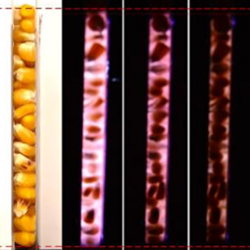
Seeds have been packed in a dielectric barrier device where cold atmospheric plasma has been generated to improve their germinative properties. A special attention has been paid on understanding the resulting plasma electrical properties through an equivalent electrical model whose experimental validity has been demonstrated here. In this model, the interelectrode gap is subdivided into 4 types of elementary domains, according to whether they contain electric charges (or not) and according to their type of medium (gas, seed or insulator). The model enables to study the influence of seeds on the plasma electrical properties by measuring and deducing several parameters (charge per filament, gas capacitance, plasma power, …) either in no-bed configuration (i.e. no seed in the reactor) or in packed-bed configuration (seeds in the reactor). In that second case, we have investigated how seeds can influence the plasma electrical parameters considering six specimens of seeds (beans, radishes, corianders, lentils, sunflowers and corns). The influence of molecular oxygen (0-100 sccm) mixed with a continuous flow rate of helium (2 slm) is also investigated, especially through filaments breakdown voltages, charge per filament and plasma power. It is demonstrated that such bed-packing drives to an increase in the gas capacitance (ξOFF), to a decrease in the β– parameter and to variations of the filaments’ breakdown voltages in a seed-dependent manner. Finally, we show how the equivalent electrical model can be used to assess the total volume of the contact points, the capacitance of the seeds in the packed-bed configuration and we demonstrate that germinative effects can be induced by plasma on four of the six agronomical specimens.

Plasma-activation of tap water using DBD for agronomy applications : identification and quantification of long lifetime chemical species and production/consumption mechanisms
– Authors : F. Judée, S. Simon, C. Bailly, T. Dufour
– References : Water Research 133 (2018) 47-59
– Links : DOI, HAL (free download)
Abstract
Cold atmospheric plasmas are weakly ionized gases that can be generated in ambient air. They produce energetic species (e.g. electrons, metastables) as well as reactive oxygen species, reactive nitrogen species, UV radiations and local electric field. Their interaction with a liquid such as tap water can hence change its chemical composition. The resulting “plasma-activated liquid” can meet many applications, including medicine and agriculture. Consequently, a complete experimental set of analytical techniques dedicated to the characterization of long lifetime chemical species has been implemented to characterize tap water treated using cold atmospheric plasma process and intended to agronomy applications. For that purpose, colorimetry and acid titrations are performed, considering acid-base equilibria, pH and temperature variations induced during plasma activation. 16 species are quantified and monitored: hydroxide and hydronium ions, ammonia and ammonium ions, orthophosphates, carbonate ions, nitrite and nitrate ions and hydrogen peroxide. The related consumption/production mechanisms are discussed. In parallel, a chemical model of electrical conductivity based on Kohlrausch’s law has been developed to simulate the electrical conductivity of the plasma-activated tap water (PATW). Comparing its predictions with experimental measurements leads to a narrow fitting, hence supporting the self-sufficiency of the experimental set, i.e. the fact that all long lifetime radicals of interest present in PATW are characterized. Finally, to evaluate the potential of cold atmospheric plasmas for agriculture applications, tap water has been daily plasma-treated to irrigate lentils seeds. Then, seedlings lengths have been measured and compared with untreated tap water, showing an increase as high as 34.0% and 128.4% after 3 days and 6 days of activation respectively. The interaction mechanisms between plasma and tap water are discussed as well as their positive synergy on agronomic results.

Promoting lentil germination and stem growth by plasma activated tap water, demineralized water and liquid fertilizer
– Authors : S. Zhang, A. Rousseau and T. Dufour
– References : RSCAdv. ,2017, 7 ,31244-31251
– Links : DOI, HAL (free download)
Abstract
Tap water, demineralized water and liquid fertilizer have been activated using an atmospheric pressure plasma jet (APPJ) to investigate their benefits for the germination rate and stem elongation rate of lentils from Puy-en-Velay (France). By plasma-activating tap water, we have obtained germination rates as high as 80% (instead of 30% with tap water). Also, higher stem elongation rates and final stem lengths were obtained using activated tap water compared with commercial fertilizer. We show that these rates of germination and stem growth strongly depend on the combination of two radicals generated in the liquids by the plasma: hydrogen peroxide and nitrate. This synergy appears to be a condition for releasing seed dormancy through the endogenous production of NO radicals.
 Thierry Dufour, Dr. - Academic research