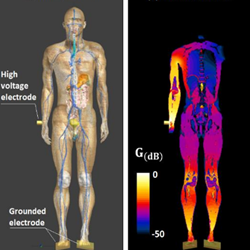
Plasma gun for medical applications : engineering an equivalent electrical target of human body and deciphering relevant electrical parameters
– Authors : F. Judée, T. Dufour
– References : Journal of Physics D : Applied Physics, Letter, Vol. 52, Issue 16, 2019
– Links : DOI, HAL (free download)
Abstract
Simulations and experimental works have been carried out in a complementary way to engineer a basic material target mimicking the same dielectric properties of the human body. It includes a resistor in parallel with a capacitor, whose values (Rh=1500 Ω and Ch=100 pF) are estimated in regard of parameters commonly utilized upon in vivo campaigns (frequency=30 kHz, gap=10 mm, high voltage electrode surface=12.6 mm2). This equivalent electrical human body (EEHB) circuit can be used as a reference and realistic target to calibrate electrical properties of therapeutic plasma sources before their utilization on patients. In this letter, we consider a configuration where this EEHB target interacts with a plasma gun (PG). Plasma power measurements performed in such configuration clearly indicate two operating modes depending on the value of the supplied voltage. Hence, the plasma gun generates pulsed atmospheric plasma streams likely to present therapeutic interest for voltages comprised between 3.0 and 8.5 kV while for higher values, transient arcs of thermal plasma are generated and represent substantial risks for the patient.

Understanding polyethylene surface functionalization by an atmospheric He/O2 plasma through combined experiments and simulations
– Authors : T. Dufour, J. Minnebo, S. Abou Rich, E. C. Neyts, A. Bogaerts, F. Reniers
– References : J. Phys. D : Appl. Phys., 2014, Vol. 47, Issue 22, 224007 (12 pp)
– Links : DOI, HAL (free download)
Abstract
High density polyethylene surfaces were exposed to the atmospheric post-discharge of a radiofrequency plasma torch supplied in helium and oxygen. Dynamic water contact angle measurements were performed to evaluate changes in surface hydrophilicity and angle resolved X-ray photoelectron spectroscopy was carried out to identify the functional groups responsible for wettability changes and to study their subsurface depth profiles, up to 9 nm in depth. The reactions leading to the formation of C–O, C=O and O–C=O groups were simulated by molecular dynamics. These simulations demonstrate that impinging oxygen atoms do not react immediately upon impact but rather remain at or close to the surface before eventually reacting. The simulations also explain the release of gaseous species in the ambient environment as well as the ejection of low molecular weight oxidized materials from the surface.

Experimental study and simulation of a micro-discharge with limited cathode area
– Authors : T. Dufour, L.J. Overzet, R. Dussart, L.C. Pitchford, N. Sadeghi, P. Lefaucheux, M. Kulsreshath, P. Ranson
– References : The European Physical Journal D, 2010, Vol. 60, Issue 3, 565-574
– Links : DOI, HAL (free download)
Abstract
We report in this paper simulation results and experimental measurements to characterize a micro-discharge generated in a single micro cavity device operating in helium. By spatially limiting the cathode surface area using a dielectric layer, we demonstrate the ability of the micro-discharge to work in a steady-state abnormal glow regime. The physical properties of this regime are discussed.

