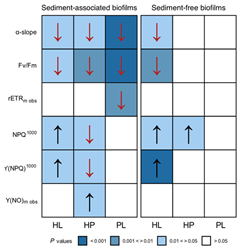
Reactive oxygen species trigger downward vertical migration in diatom microphytobenthic biofilms as a strategy to cope with oxidative stress
– Authors : A. Desparmet, B. Jésus, T. Robinet, T. Dufour, C. Hubas
– References : The ISME Journal, wrag034 (2026)
– Links : DOI, HAL (Free download)
Abstract
Diatom-dominated intertidal microphytobenthic biofilms experience daily fluctuations in irradiance, which can lead to oxidative stress within the photosynthetic apparatus through the production and accumulation of reactive oxygen species. To maintain photosynthetic efficiency, benthic diatoms have developed protective strategies, including mobilization of the antioxidant xanthophyll cycle and the ability to migrate vertically through sediments. However, mechanistic understanding of signaling pathways underlying migration remains poorly characterized. This study investigated the triggering effect of reactive oxygen species on behavioral and photophysiological responses through the analysis of lipophilic pigments and fluorescence parameters. To this end, two microphytobenthic communities, one with sediment allowing vertical migration and another without sediment restricting it, were exposed to irradiance, cold atmospheric plasma, and hydrogen peroxide stresses. Results showed a consistent downward migration response under all oxidative stresses, highlighting the key role of reactive oxygen species, especially hydrogen peroxide, in triggering this microphytobenthic behavior. Moreover, a difference was observed between the pathways involved in vertical migration and those underlying photoprotective responses. Hydrogen peroxide and cold atmospheric plasma stresses highlighted the necessity for substantial microphytobenthic migration, whereas irradiance induced a specific and controlled response involving engagement of the xanthophyll cycle, acting in synergy with the migration strategy by showing stronger activation when migration was impaired. By establishing that a rapid and efficient migration could be induced by reactive oxygen species (ROS) and could act in synergy with the xanthophyll cycle in epipelic cells, this study provides key insights into the molecular basis of microphytobenthic responses to cellular and environmental oxidative stresses.
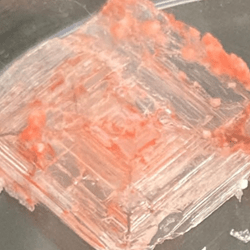
Molecular acclimation of halobacterium salinarum to halite brine inclusions
– Authors : C. Favreau, A. Tribondeau, M. Marugan, F. Guyot, B. M. Alpha-Bazin, M. Arul, R. Puppo, T. Dufour, A. Huguet, S. Zirah, A. Kish
– References : Front. Microbiol., 13:1075274 (2023)
– Links : DOI, Free download
Abstract
Halophilic microorganisms have long been known to survive within the brine inclusions of salt crystals, as evidenced by the change in color for salt crystals containing pigmented halophiles. However, the molecular mechanisms allowing this survival has remained an open question for decades. While protocols for the surface sterilization of halite (NaCl) have enabled isolation of cells and DNA from within halite brine inclusions, “-omics” based approaches have faced two main technical challenges: (1) removal of all contaminating organic biomolecules (including proteins) from halite surfaces, and (2) performing selective biomolecule extractions directly from cells contained within halite brine inclusions with sufficient speed to avoid modifications in gene expression during extraction. In this study, we tested different methods to resolve these two technical challenges. Following this method development, we then applied the optimized methods to perform the first examination of the early acclimation of a model haloarchaeon (Halobacterium salinarum NRC-1) to halite brine inclusions. Examinations of the proteome of Halobacterium cells two months post-evaporation revealed a high degree of similarity with stationary phase liquid cultures, but with a sharp down-regulation of ribosomal proteins. While proteins for central metabolism were part of the shared proteome between liquid cultures and halite brine inclusions, proteins involved in cell mobility (archaellum, gas vesicles) were either absent or less abundant in halite samples. Proteins unique to cells within brine inclusions included transporters, suggesting modified interactions between cells and the surrounding brine inclusion microenvironment. The methods and hypotheses presented here enable future studies of the survival of halophiles in both culture model and natural halite systems.

