From repeatability to self-organization of guided streamers propagating in a jet of cold plasma
– Authors : H. Decauchy, T. Dufour
– References : MDPI, Plasma, Vol. 6, pp. 250-276 (2023)
– Links : DOI, Free download
Abstract
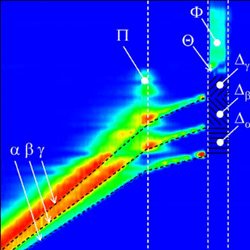
In this work, a jet of cold plasma is generated in a device supplied in helium and powered with a high-voltage nanopulse power supply, hence generating guided streamers. We focus on the interaction between these guided streamers and two targets placed in a series: a metal mesh target (MM) at floating potential followed by a metal plate target (MP) grounded by a 1500 Ω resistor. We demonstrate that such an experimental setup allows to shift from a physics of streamer repeatability to a physics of streamer self-organization, i.e., from the repetition of guided streamers that exhibit fixed spatiotemporal constants to the emergence of self-organized guided streamers, each of which is generated on the rising edge of a high-voltage pulse. Up to five positive guided streamers can be self-organized one after the other, all distinct in space and time. While self-organization occurs in the capillary and up to the MM target, we also demonstrate the existence of transient emissive phenomena in the inter-target region, especially a filamentary discharge whose generation is directly correlated with complexity order Ω. The mechanisms of the self-organized guided streamers are deciphered by correlating their optical and electrical properties measured by fast ICCD camera and current-voltage probes, respectively. For the sake of clarity, special attention is paid to the case where three self-organized guided streamers (α, β and γ) propagate at vα = 75.7 km·s–1, vβ = 66.5 km·s–1 and vγ = 58.2 km·s–1), before being accelerated in the vicinity of the MM target.

Transmission and multiple reflection mechanisms of guided streamers propagating through grounded annular electrode and interacting with grounded surface electrode
– Authors : H. Decauchy, T. Dufour
– References : Plasma Sources Science and Technology, Vol. 31, No. 11 (2022)
– Links : DOI, HAL (free download)
Abstract
The repeatable dynamics and the reversal propagation of guided streamers remains a major question of fundamental physics. In this article, trains of positive guided streamers are generated within an atmospheric pressure plasma jet supplied in helium and polarized by a high-voltage nanosecond pulse generator. The device is completed by two distant targets: a grounded annular electrode coaxially centered around the capillary through which guided streamers can propagate, and a grounded surface electrode on which they can interact. The resulting transmitted and multiple reflected guided streamers are measured combining optical characterization (fast ICCD imaging) and electrical characterization (high voltage probe and current monitors). While the electrical approach provides information on the capacitive/conductive nature of the current peaks as well as on their positive/negative value, fast ICCD imaging distinguishes whether the guided streamers are incident, reflected or transmitted. Combining these two techniques allow us to demonstrate experimentally that the reflected streamers are negative contrarily to the others. Besides, 4 types of reflections have been highlighted: a reflection (r) at the outlet of the capillary, a reflection on the grounded surface electrode (R) and two reflections (r’ and r”) observed when an incident guided streamer passes through the grounded annular electrode. The two techniques agree that the characteristic propagation times are always shorter for reflected negative streamers than for the positive ones propagating forward. Hence, for a grounded annular electrode placed 3 cm away from the high voltage electrode, propagation time is 80 ns for reflection versus 250 ns for transmission. These characteristic propagation times are even shorter when the annular electrode is brought closer to the surface electrode with velocities typically higher than 300 km/s. In addition, the intensity ratios of reflected/incident guided currents drop sharply, typically losing one decade over a counter-propagation length of only 3-5 cm. Finally, all these experimental data are utilized to build an equivalent electrical model that allow to better understand the dynamics of the guided streamers and explain their transmission and reflection modes upon their interaction with the two distant grounded electrodes.

Self-organized patterns by a DC pin liquid anode discharge in ambient air : effect of liquid types on formation
– Authors : S. Zhang, T. Dufour
– References : Physics of Plasmas 25, 073502 (2018)
– Links : DOI, HAL (free download)
Abstract
A pin liquid anode DC discharge is generated in open air without any additional gas feeding to form self-organized patterns (SOPs) on various liquid interfaces. Axially resolved emission spectra of the whole discharge reveal that the self-organized patterns are formed below a dark region and are visible mainly due to the N2 (C3 PI-B3 PI) transitions. The high energy N2 (C) level is mainly excited by the impact of electrons heated by the local increased electric field at the interface. For the first time, the effect of the liquid type on the SOP formation is presented. With almost the same other discharge conditions, the formed SOPs are significantly different from HCl and H2SO4 liquid anodes. The SOP difference is repeated when the discharge current and gap distance change for both liquid anodes. The variations of SOP size and discretization as a function of discharge current and gap distance are discussed and confirm that different SOPs are formed by the HCl liquid anode from tap water or the H2SO4 liquid anode. A possible explanation is brought up to explain the dependence of SOPs on the liquid type.

Reactivity of water vapor in an atmospheric argon flowing post-discharge
– Authors : S. Collette, T. Dufour, F. Reniers
– References : Plasma Sources Science & Technology, 2016, Vol. 25, No 2, 025014
– Links : DOI, HAL (free download)
Abstract
The reactivity of water vapor introduced in the flowing post-discharge of an RF atmospheric plasma torch is investigated through electrical characterization, optical emission spectroscopy and mass spectrometry measurements. Due to the technical features of the plasma torch, the post-discharge can be considered as divided into two regions: an inner region (inside the plasma torch device) where the water vapor is injected and an outer region which directly interacts with the ambient air. The main reactions induced by the injection of water vapor are identified as well as those indicative of the influence of the ambient air. Plausible pathways allowing the production of H, OH, O radicals and H2O2 are discussed as well as reactions potentially responsible for inhomogeneities and for a low DC current measured in the flowing post-discharge.
Ignition and extinction phenomena in helium micro-hollow cathode discharges
– Authors : M. K. Kulsreshath, N. Sadeghi, L. Schwaederle, T. Dufour, L. J. Overzet, P. Lefaucheux, R. Dussart
– References : J. Appl. Phys., 2013, Vol. 114, 243303 (8 pp)
– Links : DOI, HAL (free download)
Abstract
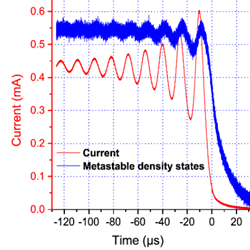
Micro hollow cathode discharges (MHCD) were produced using 250 μm thick dielectric layer of alumina sandwiched between two nickel electrodes of 8 μm thickness. A through cavity at the center of the chip was formed by laser drilling technique. MHCD with a diameter of few hundreds of micrometers allowed us to generate direct current discharges in helium at up to atmospheric pressure. A slowly varying ramped voltage generator was used to study the ignition and the extinction periods of the micro-discharges. The analysis was performed by using electrical characterization of the V-I behavior and the measurement of He(3S1) metastable atoms density by tunable diode laser spectroscopy. At the ignition of the micro-discharges, 2 μs long current peak as high as 24 mA was observed, sometimes followed by low amplitude damped oscillations. At helium pressure above 400 Torr, an oscillatory behavior of the discharge current was observed just before the extinction of the micro-discharges. The same type of instability in the extinction period at high pressure also appeared on the density of He(3S1) metastable atoms but delayed by a few μs relative to the current oscillations. Metastable atoms thus cannot be at the origin of the generation of the observed instabilities.

Influence of ambient air on the flowing afterglow of an atmospheric pressure Ar/O2 radiofrequency plasma
– Authors : C. Y. Duluard, T. Dufour, J. Hubert, F. Reniers
– References : J. Appl. Phys., 2013, Vol. 113, Issue 9, 093303 (12 pp)
– Links : DOI, HAL (free download)
Abstract
The influence of ambient air on the flowing afterglow of an atmospheric pressure Ar/O2 radiofrequency plasma has been investigated experimentally. Spatially resolved mass spectrometry and laser induced fluorescence on OH radicals were used to estimate the intrusion of air in between the plasma torch and the substrate as a function of the torch-to-substrate separation distance. No air is detected, within the limits of measurement uncertainties, for separation distances smaller than 5 mm. For larger distances, the effect of ambient air can no longer be neglected, and radial gradients in the concentrations of species appear. The Ar 4p population, determined through absolute optical emission spectroscopy, is seen to decrease with separation distance, whereas a rise in emission from the N2(C–B) system is measured. The observed decay in Ar 4p and N2(C) populations for separation distances greater than 9 mm is partly assigned to the increasing collisional quenching rate by N2 and O2 molecules from the entrained air. Absorption measurements also point to the formation of ozone at concentrations from 1014 to 1015 cm–3, depending both on the injected O2 flow rate and the torch-to-substrate separation distance.

Chemical mechanisms inducing a DC current measured in the flowing post-discharge of an RF He-O2 plasma torch
– Authors : T. Dufour, J. Hubert, N. Vandencasteele, F. Reniers
– References : Plasma Sources Science & Technology, 2012, Vol. 21, Issue 4, 045013 (10 pp)
– Links : DOI, HAL (free download)
Abstract
The post-discharge of an RF plasma torch supplied with helium and oxygen gases is characterized by mass spectrometry, optical emission spectroscopy and electrical measurements. We have proved the existence of a dc current in the post-discharge (1–20μA), attributed to the Penning ionization of atmospheric nitrogen and oxygenated species. The mechanisms ruling this dc current are investigated through experiments in which we discuss the influence of the O2 flow rate, the He flow rate and the distance separating the plasma torch from a material surface located downstream.

Integrated micro-plasmas in silicon operating in helium
– Authors : R. Dussart, L.J. Overzet, P. Lefaucheux, T. Dufour, M. Kulsreshath, P. Ranson, J.B. Lee, M. Goeckner
– References : The European Physical Journal D, 2010, Vol. 60, Issue 3, 601-608
– Links : DOI, HAL (free download)
Abstract
Microplasma arrays operating in helium in a DC regime have been produced in silicon microreactors. Cathode boundary layer (CBL) type microdevices were elaborated using clean room facilities and semiconductor processing techniques. Ignition of the micro-discharge arrays having either 50 or 100 μm diameter cavities was studied. Two different structures (isotropically etched or anisotropically etched cavity) and various conditions (the two different voltage polarities, pressures etc.) were investigated. 100 microdischarges of 50 μm diameter could be ignited in parallel at 1000 Torr. At high current, some parasitic and transient sparks appeared at the edge of the sample. When the polarization was reversed (cathode side corresponding the opened electrode), more current was needed to light all the microdischarges. A thermally affected zone around the hole on the anode side was obtained after operation.

Experimental study and simulation of a micro-discharge with limited cathode area
– Authors : T. Dufour, L.J. Overzet, R. Dussart, L.C. Pitchford, N. Sadeghi, P. Lefaucheux, M. Kulsreshath, P. Ranson
– References : The European Physical Journal D, 2010, Vol. 60, Issue 3, 565-574
– Links : DOI, HAL (free download)
Abstract
We report in this paper simulation results and experimental measurements to characterize a micro-discharge generated in a single micro cavity device operating in helium. By spatially limiting the cathode surface area using a dielectric layer, we demonstrate the ability of the micro-discharge to work in a steady-state abnormal glow regime. The physical properties of this regime are discussed.

RF impedance measurements of DC atmospheric micro-discharges
– Authors : L.J. Overzet, D. Jung, M.A. Mandra, M. Goeckner, T. Dufour, R. Dussart, P. Lefaucheux
– References : The European Physical Journal D, 2010, Vol. 60, Issue 3, 449-454
– Links : DOI, HAL (free download)
Abstract
The available diagnostics for atmospheric micro-plasmas remain limited and relatively complex to implement; so we present a radio-frequency technique for diagnosing a key parameter here. The technique allows one to estimate the dependencies of the electron density by measuring the RF-impedance of the micro-plasma and analyzing it with an appropriate equivalent circuit. This technique is inexpensive, can be used in real time and gives reasonable results for argon and helium DC micro-plasmas in holes over a wide pressure range. The electron density increases linearly with current in the expected range consistent with normal glow discharge behavior.

Effect of limiting the cathode surface on DC micro-hollow cathode discharge in helium
– Authors : T. Dufour, R. Dussart, P. Lefaucheux, P. Ranson, L. Overzet, M. Mandra, J.-B. Lee, M. Goeckner
– References : Applied Physics Letters, 2008, Vol. 93, Issue 7, 071508,
– Links : DOI, HAL (free download)
Abstract
This paper describes how to light several microdischarges in parallel without having to individually ballast each one. The V-I curve of a microhollow cathode discharge is characterized by a constant voltage in the normal glow regime because the plasma is able to spread over the cathode surface area to provide the additional secondary electrons needed. If one limits the cathode surface area, the V-I characteristic can be forced into an abnormal glow regime in which the operating voltage must increase with the current. It is then possible to light several microdischarges mounted in parallel without ballasting them individually.
 Thierry Dufour, Dr. - Academic research