At the origins of electroculture: a retrodictive modelling of Bertholon’s 18th-century electrovegetometer in the pre-corona regime
– Authors : T. Dufour
– References : Compte Rendus de Mécanique de l’Académie des Sciences, Vol. 354, pp. 117-139 (2026)
– Links : DOI, HAL (Free download)
Abstract
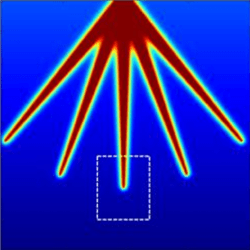
Pierre-Nicolas Bertholon’s 18th-century electrovegetometer was conceived to harness “atmospheric electricity” for plant growth, yet its physical capabilities have never been quantified within the context of today’s understanding of the Earth’s atmospheric electric system. This study addresses the lack of quantitative assessment of such historical “electroculture” device and its plausible influence on the near-canopy electrical environment. It aims to reinterpret Bertholon’s apparatus using contemporary atmospheric electrodynamics, asking under which realistic fair-weather and storm-like conditions a purely passive collector-distributor could generate fields and ion fluxes of physical significance. A two-dimensional, quasi-steady ohmic model has been developed in which the atmosphere is a resistive column carrying the global conduction current, the metal structure is a floating conductor supported by leaky wooden insulators and space-charge and corona are excluded so that all results describe pre-onset upper bounds. The simulations show that in fair weather the single upper point and the lower multi-point crown of the electrovegetometer enhance the background field by two to three orders of magnitude, yet only within millimetric-centimetric regions around the tips and with total currents limited to the pA-nA·m⁻² range. Under storm-like forcing, peak fields at the crown reach 10⁵-10⁶ V·m⁻¹, approaching or exceeding empirical corona-onset thresholds, while remaining largely insensitive to uncertainties in apex angle or collector geometry as long as an elevated mast is present. These results make Bertholon’s reports of luminous “aigrettes” physically plausible, but suggest that any fair-weather agronomic impact was subtle and highly localized and that modern “electroculture” claims require careful, coupled electrostatic and biological studies beyond the pre-corona regime.
From electroculture to plasma agriculture: A three-century arc bridging Bertholon’s legacy with contemporary farming advances
– Authors : T. Dufour
– References : Compte Rendus de Mécanique de l’Académie des Sciences, Vol. 354, pp. 89-116 (2026)
– Links : DOI, HAL (Free download)
Abstract
This review traces the historical trajectory of electricity in agriculture, from the earliest observations of electrical
phenomena to the emergence of cold plasmas. Looking back to Antiquity and then to the Enlightenment, it underlines
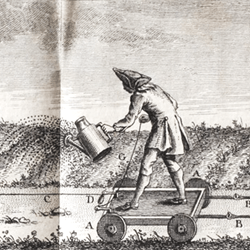
Abbé Bertholon’s 18th-century efforts to channel atmospheric electricity to stimulate crops, using devices such as the
electro-végétomètre. Although these early electroculture experiments relied on neither quantitative dosimetry nor
rigorous methodology, they foreshadowed the idea of a controlled transfer of electrical energy to plants. Then the
review examines the historical development of galvanism, electrochemistry, and the physics of gaseous discharges
throughout the 19th and 20th centuries, which collectively laid the foundations for contemporary cold-plasma
technologies. In the 21st century, plasma agriculture has emerged as an interdisciplinary approach integrating
electrical, chemical, radiative, thermal, and fluid-mechanical effects. Applications include seed treatment
(preconditioning, seed priming), stimulation of plant growth, soil and water treatment, and decontamination of agri-
food products. The review thus reassesses Abbé Bertholon’s contributions as those of a methodological precursor and
shows how his intuition of a “vivifying electricity” resonates with modern cold-plasma science. Finally, it argues that
plasma agriculture can transform an Enlightenment intuition into a reproducible experimental framework for
sustainable agriculture and food safety.
 Thierry Dufour, Dr. - Academic research